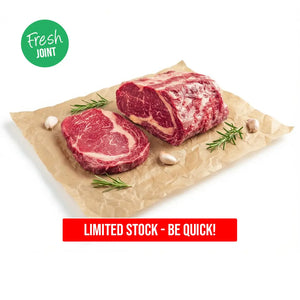
A ribeye roast is the whole boneless eye of the fore rib, the same muscle we cut into ribeye steaks, left in one piece for the oven. It is heavily marbled, with a seam of fat running through the middle, so it roasts up rich and juicy and carves into thick, rosy slices. Our whole ribeye is the Fresh Whole Gaucho Rib-eye 2-3kg: roast it whole for a crowd or slice it into steaks yourself. Below are the cooking times per kg, the core temperatures and the cutting guide. You can see every rib eye joint on the counter in ribeye roasting joints.

Skip the middle man! This is a proper butcher’s joint, not a supermarket tray of steaks. One roast gives you a Sunday dinner, a Christmas centrepiece or a freezer full of ribeye steaks, and you decide which.
What is a ribeye roast (rib eye joint of beef)?
Ribeye comes from the fore rib, between the chuck and the sirloin. When the bones are taken off a rib of beef and the joint is trimmed, the long, round muscle left behind is the ribeye. It is the most marbled of the prime roasting cuts. That fat melts as it roasts and bastes the meat from the inside, so a ribeye roast is harder to dry out than a lean topside. The flip side is that the fat needs proper heat to render. A ribeye joint cooked too rare can taste chewy around the fat eye, which is why most butchers roast it to medium-rare or medium.
How to cook a ribeye roast (step by step)
1. Weigh it. Joint weights vary, so weigh yours and write the figure down. The timings all depend on it.
2. Bring it up from cold. Take the joint out of the fridge 45 minutes to an hour before roasting and pat it dry with kitchen paper.
3. Season well. Rub it with a little oil, plenty of flaky salt and cracked black pepper. If you like, add crushed garlic and chopped rosemary or thyme. If the joint is long and loose, tie it with butcher’s string every few centimetres so it cooks evenly.
4. Start hot. Heat the oven to 220°C (fan 200°C, gas 7). Sit the joint fat side up on a trivet of halved onions and carrots in a roasting tin, then roast for 20 minutes to colour the outside. If you prefer, sear it all over in a hot pan first, as the product page suggests, then go straight to step 5.
5. Turn it down. Lower the oven to 180°C (fan 160°C, gas 4) and roast for the time per kg below. Check the core temperature in the thickest part with a probe thermometer.
6. Rest it. Lift it onto a warm board, cover it loosely with foil and leave it for 25–30 minutes. Make the gravy from the tin juices while it rests.
Ribeye roast cooking times per kg
These are the timings after the first 20 minutes at 220°C, at 180°C (fan 160°C). A whole ribeye is thick and round, so it sits towards the top of each range. Bigger joints cook slightly faster per kg, so start probing about 20 minutes before the lower figure.
| Doneness | Time per kg | 2kg joint | 2.5kg joint | 3kg joint | Take it out at |
|---|---|---|---|---|---|
| Rare | 30–35 minutes | 60–70 minutes | 75–90 minutes | 1½–1¾ hours | 48–50°C |
| Medium-rare | 35–40 minutes | 70–80 minutes | 90–100 minutes | 1¾–2 hours | 52–54°C |
| Medium | 40–45 minutes | 80–90 minutes | 100–115 minutes | 2–2¼ hours | 57–58°C |
| Well done | 50–55 minutes | 100–110 minutes | 125–140 minutes | 2½–2¾ hours | 65–68°C |
The temperature keeps climbing by about 3–5°C as the joint rests, which is why you take it out early. These times are in line with our roast beef cooking times per kg chart, which covers every other joint too.


How to cut ribeye steaks from a whole ribeye
A whole ribeye joint is the cheapest way to fill the freezer with ribeye steaks, and it only takes a sharp knife and ten minutes. Chill the joint in the fridge so it is firm. Trim off any hard, thick outer fat and any silver skin, but leave the marbling and the fat eye alone, because that is the flavour. Look for the direction of the grain and slice across it into steaks 2.5–3cm thick. To work out your yield, divide the weight of the joint by the steak size you want. For example, a 2.4kg ribeye cut into 300g steaks gives about eight. Cook them as in our How to Cook Ribeye Steak guide. For a ready-cut pack, see ribeye steaks.
If you would rather cut your own sirloins, the ANGUS Sirloin Joint 4-5kg works the same way. Every joint built for home butchery is in cut your own steaks.
Resting, carving and gravy
Do not skip the rest. It lets the juices settle back into the meat instead of running all over the board, and a joint this size stays hot under foil for half an hour. To carve, cut away the string, find the grain and slice across it, about 1cm thick for a ribeye roast. Every slice should get a little of the fat eye. For the gravy, pour most of the fat out of the tin (keep it for roast potatoes), stir a tablespoon of plain flour into the juices over a medium heat, add a splash of red wine, then gradually whisk in 500ml beef stock and simmer for five minutes. Add the resting juices and strain. If you want a shortcut, Dine- Peppercorn Sauce is a pour-over sauce made with beef stock and cream.
What to serve with roast ribeye
Treat it like the best Sunday roast you have ever made: Yorkshire puddings, roast potatoes done in Pure Goose Fat 180g, horseradish, honey-roast carrots and parsnips, buttered greens and plenty of gravy. For Christmas, it is a strong alternative to the turkey. Compare it with the other options in Best Beef Joint for Christmas Dinner, or see How to Cook a Sirloin Joint if you want something leaner. Browse every roasting joint in beef joints.


FAQ
How long does it take to cook a ribeye roast?
Weigh the joint first. Give it 20 minutes at 220°C (fan 200°C), then 180°C (fan 160°C) for 35–40 minutes per kg for medium-rare. A 2kg ribeye roast takes about 20 minutes plus 70–80 minutes, and a 3kg joint about 20 minutes plus 1 hour 45 minutes to 2 hours. Start probing early, then rest it for 25–30 minutes.
What temperature should a ribeye roast be cooked to?
As a cook’s guide to doneness, take it out at 48–50°C for rare, 52–54°C for medium-rare, 57–58°C for medium or 65–68°C for well done. The core keeps rising by a few degrees while it rests. Ribeye is at its best at medium-rare to medium, when the fat has started to melt.
Is ribeye good for roasting?
Yes. A whole ribeye joint is one of the juiciest roasting joints there is, because the marbling and the fat eye in the middle baste the meat as it cooks. It has more fat than topside or sirloin, so it is more forgiving if it goes a few minutes over.
Can you cut your own steaks from a whole ribeye?
Yes, and it is the best-value way to buy ribeye steak. Chill the joint well, trim any hard outer fat, then slice across the grain into steaks 2.5–3cm thick with a long, sharp knife. Divide the weight of the joint by the steak size you want to work out how many you will get.
Can you eat a ribeye roast pink?
Yes. Food Standards Agency guidance says whole cuts of beef, such as steaks and joints, can be served pink in the middle as long as the outside has been properly sealed and has changed colour. Rolled or stuffed joints and anything minced are different, and must be cooked until steaming hot all the way through with no pink meat.